🧩 Microservices Architecture
✅ Overview
A structural style splitting the application into small independent services, enabling independent deployment and independent scale.
✅ Problems Addressed
- Development speed slowdown of huge Monolith.
- Collision due to team scale increase.
- Response to different scale characteristics per feature.
✅ Basic Philosophy & Rules
- Independent deployment per service.
- Independent data store (Database per Service).
- Loosely coupled coordination via API (REST / gRPC / Event).
- Strong prerequisite of DevOps / CI/CD / Observability.
Conceptual Diagram
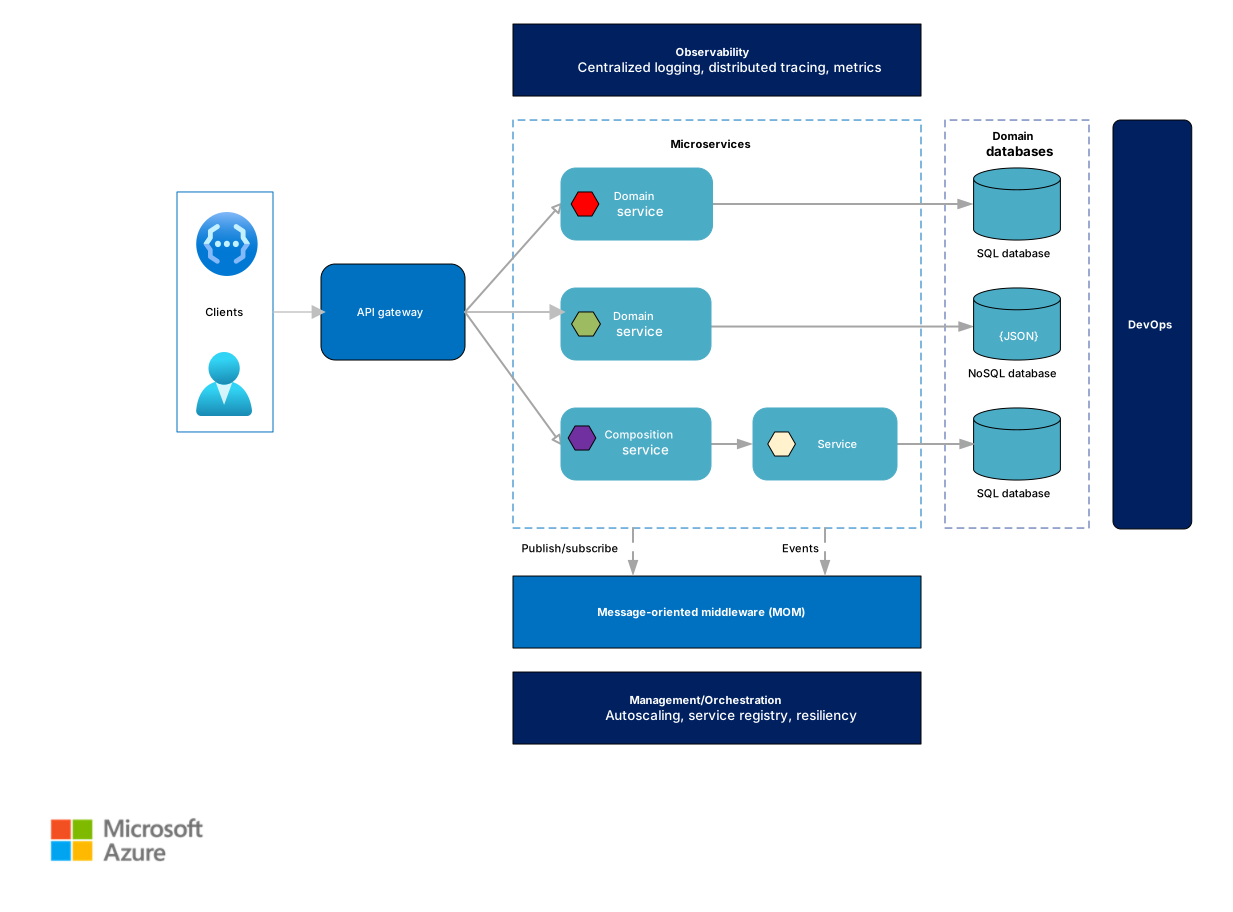
Source: Microsoft, “Microservices architecture style – Azure Architecture Center”.
https://learn.microsoft.com/en-us/azure/architecture/guide/architecture-styles/microservices
✅ Suitable Applications
- Development in multi-team / multi-domain.
- Web services with high availability / scale requirements.
- When technology selection differs per feature.
❌ Unsuitable Cases
- Small-scale products (Over-engineering).
- Heavy operation, insufficient SRE structure.
- Domains where distributed transactions occur massively.
✅ History
- Spread by success of Netflix / Amazon.
- Developed as a school implementing SOA ideas more lightly.
✅ Related Styles
- SOA: Heavier and enterprise-like ancestor.
- Modular Monolith: Effective as structural organization before introduction.
✅ Representative Frameworks
-
Spring Cloud
Comprehensive foundation for Microservices like Config / Gateway / Discovery / Circuit Breaker. -
Go + gRPC + Kubernetes
Strong combination for building lightweight and fast services. -
Node.js / NestJS / Express
Configuration suitable for BFF and small-grained services. -
AWS (ECS / Lambda / API Gateway / EventBridge)
Microservices construction by managed services. -
Dapr
Platform providing service-to-service invocation via sidecar.
✅ Design Patterns Supporting This Style
-
Facade
Unified entrance via API Gateway. -
Proxy
Traffic control by Service Mesh or Sidecar. -
Observer
Event-driven coordination and domain event distribution. -
Mediator
Coordination of multiple services by Orchestrator (Workflow). -
Strategy
Different algorithm / technology selection per service.
✅ Summary
Microservices is a powerful structure for
"High Speed Development × High Scale × High Availability",
but since operation cost is high, it depends on organizational scale and domain characteristics.