🧩 Event-driven Architecture (EDA)
✅ Overview
An integration style loosely coupling services triggered by the occurrence of events.
Publishes the fact that "something happened" as an event, and services subscribing to it react.
✅ Problems Addressed
Synchronous request type cooperation (REST/gRPC etc.) alone has challenges like:
- Chain of synchronous calls tends to occur when many services are involved in one process.
- Caller needs to know all callees (Strong coupling).
- Delay/Failure of some services directly connects to caller's response.
Event-driven Architecture (EDA) tries to enhance flexibility and fault tolerance by:
"Publishing change of state (event) and making 'who processes it' loosely coupled."
✅ Basic Philosophy & Rules
● Event
- Fact that happened in the past like "Order created", "Inventory allocated".
- Immutable, and in principle "not cancelled".
● Event Producer / Consumer
- Producer: Service publishing the event.
- Consumer: Service subscribing to the event and reacting.
- Both are connected loosely via message broker (Kafka, RabbitMQ etc.).
● Pub/Sub Model
- Publisher does not know "who is subscribing".
- Subscriber does not care "who published", only looks at events of interest.
Conceptual Diagram
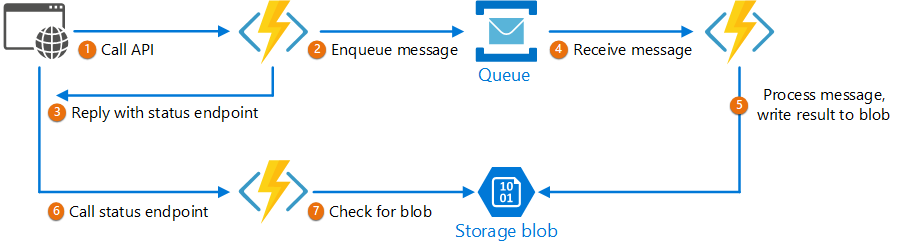
Source: Microsoft, “Asynchronous messaging patterns – Azure Architecture Center”.
https://learn.microsoft.com/en-us/azure/architecture/patterns/async-request-reply
✅ Suitable Applications
- Domains with many interactions between microservices.
- Systems performing additional processing reacting to "something happened" (Notification, Aggregation, Asynchronous Batch).
- High throughput event processing platforms (Log / Tracking / IoT).
Features:
- Easy to "add new service as subscriber of existing event".
- Natural transition to asynchronous processing.
❌ Unsuitable Cases
- Operations requiring strong consistency where "it is troublesome if result is not known immediately".
- Systems where processing flow is simple and synchronous call is sufficient.
- Teams that cannot afford cost of event design and schema management.
Also, abuse of EDA creates problems like:
- Flood of events.
- Poor visibility of dependencies (Hard to understand where and what is triggered).
✅ History (Genealogy / Parent Styles)
- Development from GUI event-driven model (reacting to clicks etc.).
- Spread of messaging systems (MQ) and Pub/Sub.
- Spread in earnest by Log + Stream platforms like Kafka.
✅ Related Styles
- Saga Pattern: Performs distributed transaction control with events.
- Streaming Pipeline: Continuously processes event streams.
- CQRS / Event Sourcing: Style treating events as data model.
✅ Representative Frameworks
Event-driven Architecture is realized on messaging infrastructure or event platforms.
-
Apache Kafka
High throughput distributed log / stream platform. Representative implementation of EDA. -
RabbitMQ
Used as message broker in both Queuing type and Pub/Sub type. -
Amazon SNS / SQS / EventBridge
Major components of event-driven integration on AWS. -
Google Cloud Pub/Sub
Global Pub/Sub service in GCP. -
NATS / Pulsar etc.
Increasing adoption as lightweight and high-performance messaging infrastructure.
✅ Design Patterns Supporting This Style
Internal structure of Event-driven can be decomposed into object-oriented patterns as follows:
-
Observer
Model of Event Publishing (Subject) and Subscription (Observer) itself. -
Mediator
Message broker functions as a mediator between Producer and Consumer. -
Command
Treats event as "operation object", and Consumer side interprets its meaning. -
Chain of Responsibility
Appears in structure where multiple handlers/consumers take over processing in order. -
Iterator
Used as abstraction when processing event streams sequentially.
✅ Summary
Event-driven Architecture is an integration style emphasizing:
- Loose Coupling
- Asynchronous Processing
- Extensibility
It is important not to make everything event-driven, but to
Identify "where event-driven brings high value" while combining with synchronous calls.