🧩 Clean Architecture
✅ Overview
A style that reorganized concepts from Hexagonal / Onion and summarized them as clear layer structures and dependency rules:
- Entities (Enterprise Business Rules)
- Use Cases (Application Business Rules)
- Interface Adapters
- Frameworks & Drivers
✅ Problems Addressed
- Concepts like Hexagonal / Onion / Layered / DDD were proliferating, making differences hard to understand.
- Wanted to organize the common idea of "Dependencies point inward" and "Domain centric".
- Wanted more guidance on specifically what to write in which layer.
Clean Architecture can be understood as:
A unified diagram reorganizing existing styles by "Dependency Rules" and "Layers".
✅ Basic Philosophy & Rules
● Layer Structure
-
Entities
- Business rules valid across systems.
- Close to Entities / Value Objects in DDD.
-
Use Cases
- Application-specific use cases.
- Input/output control, transaction boundaries, etc.
-
Interface Adapters
- Presenter / Controller / Repository implementations, etc.
- Convert external data formats to inner models.
-
Frameworks & Drivers
- Web Frameworks / DB / Messaging, etc.
● Dependency Rule
- Dependencies point only inward (to Entities).
- The inside does not know about the outside.
- The outside depends on the inside's interface.
Conceptual Diagram
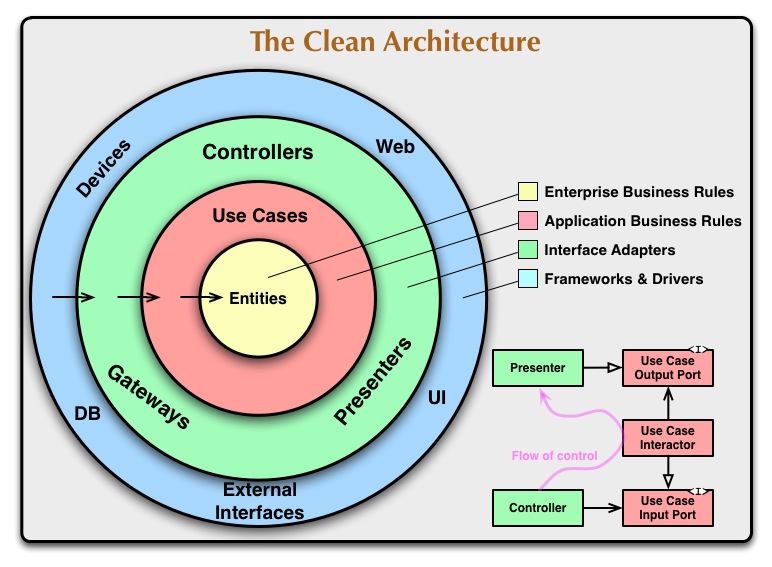
Source: Robert C. Martin, “The Clean Architecture”, 2012. https://blog.cleancoder.com/uncle-bob/2012/08/13/the-clean-architecture.html
✅ Suitable Applications
- Business systems with medium to high domain complexity.
- Products assuming long-term operation and multi-team development.
- Backends that do not want to be tied to frameworks.
- Development prioritizing automated tests and use-case unit tests.
❌ Unsuitable Cases
- Short-lived small CRUD apps.
- When the team's experience level is low and the cost of maintaining the layer structure is higher.
If layers are introduced only in form:
- Only the number of classes and folder hierarchy increases.
- Dependency rules are not actually observed.
There is a danger of this happening.
✅ History (Genealogy / Parent Styles)
- Proposed by Robert C. Martin (Uncle Bob).
- A style that organized and summarized flows like Hexagonal / Onion / DDD / Layered.
- Widely popularized as the book "Clean Architecture".
✅ Related Styles
- Hexagonal Architecture: Concept of Ports & Adapters.
- Onion Architecture: Layer structure on concentric circles.
- DDD: As a concrete expression method for Entities / Use Cases.
✅ Representative Frameworks
Clean Architecture is also a concept independent of frameworks, but in practice, it is often practiced in the following technology stacks.
-
ASP.NET Core / .NET
Many official/community templates like "Clean Architecture Template" exist. -
Spring Boot (Java)
Configurations clearly separating Entities / Use Cases / Interface Adapters / Frameworks & Drivers are introduced. -
NestJS (Node.js)
Easy to split into UseCase / Repository Interface / Adapter Implementation, making it easy to align with Clean-like structure.
✅ Design Patterns Supporting This Style
In Clean Architecture, multiple patterns are combined to support dependency rules and use-case centric design.
-
Adapter
Functions as a bridge between external I/O and internal models in the Interface Adapters layer. -
Strategy
Expresses variations of business rules and use cases in a replaceable form. -
Command
Objectifies a Use Case as "one operation", clarifying input/output and transaction boundaries. -
Facade
Provides multiple use cases as a unified interface when viewed from the outside (UI / API). -
Abstract Factory
Used to assemble appropriate implementation adapters (for production / test) at runtime.
✅ Summary
Clean Architecture is a style that summarizes modern architectural key ideas:
- Domain-centric design
- Thorough dependency rules
- Framework independence
Into a simple diagram and rule set.
Rather than "observing it perfectly", it is realistic to use it as a common language for the team to share the principle of keeping dependencies inward.