

Current Focus / Reproducibility
Using AI to scale a small team’s work
TAKT R&D intends to stay a small team of specialists as we grow. But when decisions and ways of working reside with a few individuals, every new project competes for their time. We use AI to turn how we work and make decisions into software that others can use, check, and improve.
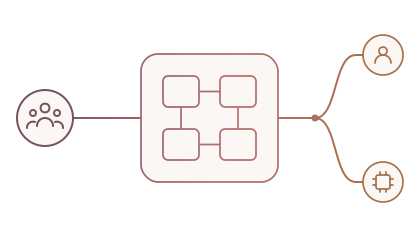
Four parts of reproducible work
- Decision MakingDecision-3In testing
- Decision-3 looks at each decision from three perspectives: Practice, Value, and Restraint. Each examines the options, then the group considers the reasoning and disagreements before deciding.
- BehaviorTAKT FrameworkIn use
- We set the context and quality criteria up front and improve the work through feedback. People check in where judgment is needed, not just at final approval.
- KnowledgeRAGIn use
- Retrieval-augmented generation gives AI relevant source material at the point of use and lets people trace an answer back to its evidence.
- ExperienceObsidianIn testing
- We are testing how to capture what we tried, why we made a decision, and what happened, so the lessons from one job are available for the next.
(Context + Quality Gate) x Feedback Loop + Human-in-the-loop
Can a factory work as a business?
If the four parts work together and their evaluation criteria align, a Software Factory could work in principle. So could a Dark Factory, where people do not run the routine steps themselves.
The public examples we have examined report more pull requests or faster delivery, but do not show how those gains translate into business performance. A working prototype is only the start. We need to know whether we can sustain quality at a cost that includes review and rework.
At our scale, running frontier models at every step is too expensive. Compute is finite, and today’s subscription prices may not last beyond the adoption phase. We are not designing a workflow that only works at today’s prices.
AI Farm
Different Actor, Same Result
We deliberately test without frontier models or high-end hardware. Under tight computing constraints, can different models meet the same quality standard for real work? Those limits force us to rethink how we split up work and verify the results. That is where we expect new methods to emerge.
Set boundaries on what AI can do.
Autonomous AI agents can use tools, retrieve files, and change systems on their own. An agent could accidentally change a production system or bring in malware through a downloaded tool or dependency. We design the farm to limit what agents can reach and to keep an incident from spreading to the products we provide or to other devices on the network.
Zero Trust
We design on the assumption that the cheapest way in is through us. In everyday work, that can mean a person; in the AI Farm, an agent. Both can mistake a convincing request for an authorized instruction. By default, we trust neither ourselves nor the agents we run. We verify what is authorized and grant only the access the task needs.
Segment the network
Separate the farm from production systems and everyday devices. Allow traffic between segments only where the work requires it.
Deny outbound traffic by default
Block internet access by default. Keep updates and model downloads out of the agent’s workflow. Verify the source and contents through a separate maintenance path before bringing them in.
Give each task only the access it needs
Limit which files a task can read or write and which tools it can use. Keep administrator access and production credentials out of the runtime. Instructions found in external documents cannot grant permissions.
Make actions traceable and stoppable
Log tool actions and changes, and make it possible to stop a run when something goes wrong. Keep publishing and production changes outside the AI workflow, with a person accountable for those decisions.
For our broader approach to designing defenses around attack paths, see Security.
Last updated: